Maintaining the luxurious appearance of kitchen and bathroom countertops is crucial for protecting your investment. If you own quartz surfaces, you may wonder if the specialty cleaner you use for granite is safe. The short answer is: It depends entirely on the cleaner’s formulation. Using the wrong product can void your warranty, dull the surface, or leave behind a permanent haze. This guide explains the differences between these two popular materials and outlines the definitive best practices for keeping your quartz countertops pristine.
Understanding the Difference Between Granite and Quartz
The core reason you cannot treat all granite and quartz cleaners as interchangeable lies in their fundamental material composition.
Porous vs. Non-Porous Surfaces
- Granite (Natural Stone): Granite is mined directly from the earth and is $100\%$ natural. It is a porous material, meaning it has tiny, interconnected holes and capillaries that can absorb liquids. Because of this porosity, granite must be regularly treated with a sealant (usually every $6$ to $12$ months) to prevent liquids, oils, and bacteria from sinking deep into the stone and causing permanent staining or etching.
- Quartz (Engineered Stone): Quartz is an engineered surface, typically composed of $90\%$ to $95\%$ ground natural quartz minerals mixed with $5\%$ to $10\%$ polymer resins (plastic) and pigments. The presence of the polymer resins makes quartz non-porous and completely non-absorbent. It does not require sealing and is highly resistant to stains and bacteria growth, as liquids simply pool on the surface.
Why Some Cleaners May Not Be Compatible
The conflicting nature of these materials dictates the cleaning requirements:
- Granite Cleaners Often Contain Sealants: Many specialty granite cleaners are designed to not only clean but also boost the stone’s existing sealant during routine maintenance. Applying a sealant or wax to quartz is unnecessary and counterproductive, as the non-porous resin surface cannot absorb it.
- Quartz Reacts Poorly to Harsh Chemicals: The resin binder in quartz is vulnerable to harsh acids, solvents, and strong abrasives. While high-quality granite can tolerate stronger alkaline or acidic cleaners (briefly, before rinsing), the resin in quartz will break down, leading to irreversible surface damage, cloudiness, or permanent etching.
When Granite Cleaner Is Safe to Use
You can safely use a granite cleaner on a quartz countertop only if you verify its chemical composition. If the bottle is not clearly labeled, it is safer to stick to mild soap and water.
Look for pH-Neutral, Non-Abrasive Formulas
The only granite cleaners considered safe for quartz are those explicitly labeled as pH-neutral (or pH-balanced).
- pH-Neutrality: A pH of $7$ is perfectly neutral. Any cleaner with a pH near this level will not damage the resin binder in quartz or the sealant on granite. These cleaners rely on gentle surfactants to lift grease and dirt without chemical degradation.
- Non-Abrasive: Ensure the cleaner is liquid or spray-based. Avoid powdered cleaners or scouring pads, as the abrasive particles can scratch or dull the resin-based finish of the quartz.
Avoid Cleaners Containing Sealants or Wax
Always check the ingredients list. If the granite cleaner promises to “condition,” “polish,” “seal,” or “enhance luster” using wax or polymer additives, do not use it on quartz.
- The Haze Risk: These sealant additives are designed to absorb slightly into porous stone. When applied to non-porous quartz, they simply sit on the surface, cure, and create a waxy, cloudy, or sticky residue that is extremely difficult to remove without harsh solvents. This is the single biggest risk when mixing cleaners.
Best Cleaners for Quartz Countertops
For daily and weekly maintenance, the safest, most effective, and most manufacturer-recommended cleaning solutions are simple household staples.
Mild Dish Soap + Warm Water Solution
This is the gold standard for daily quartz cleaning. Mild dish soap (like Dawn or Palmolive) is pH-neutral and contains surfactants that are excellent at breaking down the common messes found in a kitchen—grease, food residue, and sticky spills—without harming the engineered stone.
Application Method:
- Mix a small amount (about $1$ teaspoon) of mild dish soap into a quart of warm water.
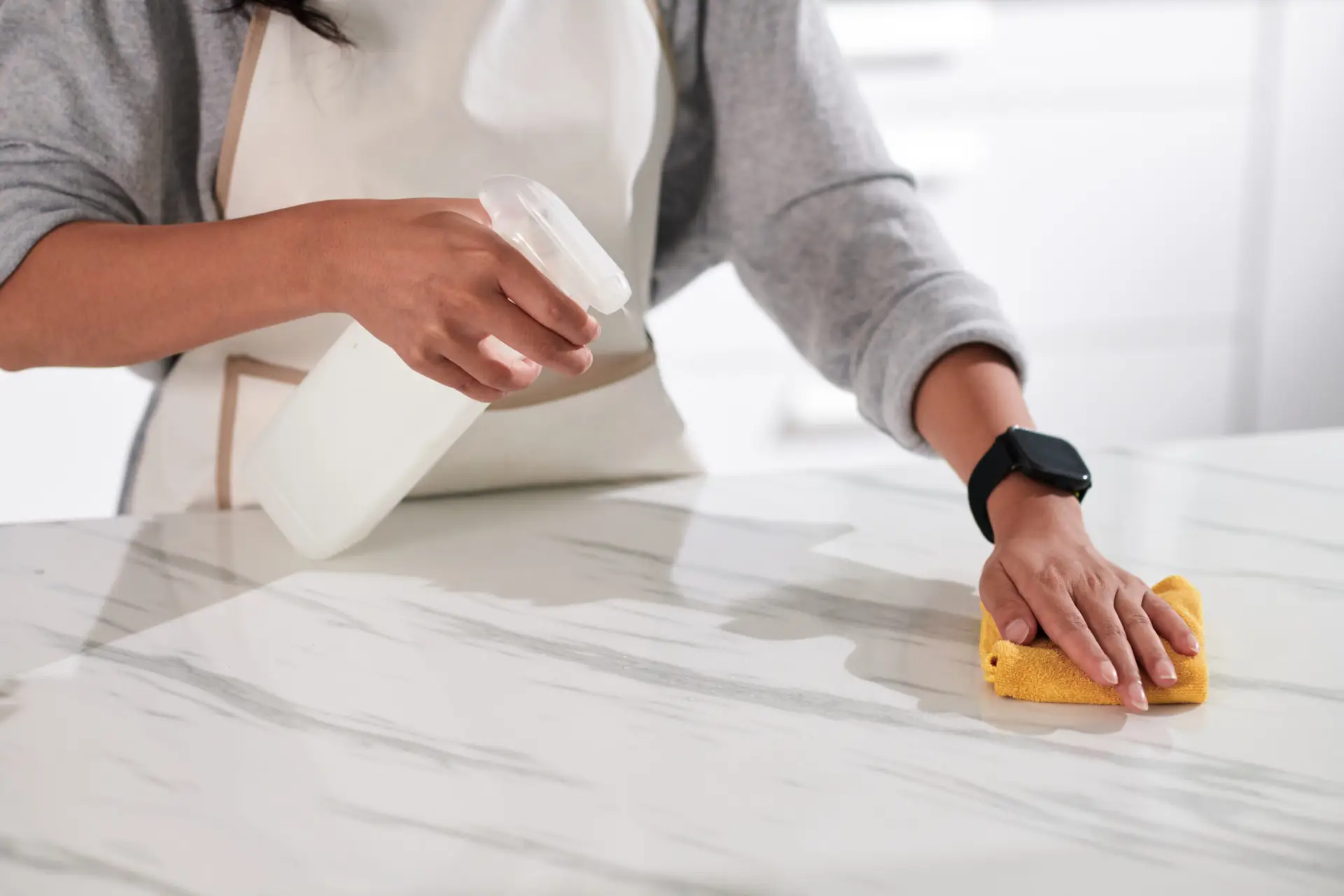
- Dip a soft sponge or cloth into the solution, wring it out until damp, and wipe the entire surface.
- Crucial Step: Follow immediately with a wipe of plain water to rinse away all soap residue.
Alcohol-Based Sprays for Disinfecting
For occasional sanitization, especially after preparing raw meat or handling food, a diluted alcohol solution is safe for quartz.
- A simple $70\%$ Isopropyl Alcohol spray, or a product containing a small amount of rubbing alcohol, can be used. Alcohol evaporates quickly and is effective at killing germs without leaving corrosive residue.
- Limit Use: While safe, relying on alcohol for daily cleaning is unnecessary. Save it for disinfecting spills.
Tips for Maintaining a Streak-Free Finish
Quartz is known for its beautiful, uniform luster. Keeping it streak-free requires careful technique during the final steps of cleaning.
Dry with Microfiber Cloths
Water and cleaning residue left to air-dry are the primary culprits behind streaks and cloudiness.
- After rinsing the soap solution, use a dry, clean, high-quality microfiber cloth to buff the countertop.
- Microfiber is non-abrasive and highly absorbent, picking up any residual moisture or cleaning film left on the non-porous surface, guaranteeing a sparkling, streak-free finish.
Avoid Acidic or Ammonia-Based Products
These products directly attack the resin binder in quartz, causing irreparable damage:
- Acidic Cleaners: Lemon juice, vinegar, oven cleaners, drain cleaners, and rust removers can permanently etch or dissolve the resin, leaving dull, discolored areas.
- Ammonia: Found in many glass and window cleaners (like Windex), ammonia is too harsh for repeated use and can break down the bond between the quartz and the resin over time. Always check the label before using a glass cleaner.
FAQs
Can I use glass cleaner on quartz?
You can, but proceed with caution. Many popular glass cleaners contain ammonia or high levels of alcohol. While a quick, occasional wipe may be fine, frequent use of ammonia-based glass cleaner is discouraged as the chemical can slowly degrade the resin and dull the finish of the quartz over time. If you use glass cleaner, opt for an ammonia-free formula.
How often should quartz be cleaned?
For a busy kitchen, a quick wipe-down with the dish soap and water solution should be done daily (or after every major food preparation session) to prevent spills from drying and hardening. A more detailed cleaning focusing on corners and edges should be performed weekly. Since quartz is non-porous, a deep cleaning process (like the one required for granite) is never necessary.
Focus on the sparkle, not the scrubbing.
If you are struggling to keep your kitchen and bathrooms spotless, or if you simply want to ensure your valuable countertops are treated with the specialized care they require, let the professionals handle it.
Contact Clean Day Maids today to schedule an expert cleaning service that uses only pH-neutral, resin-safe products guaranteed to leave your quartz surfaces pristine and streak-free.