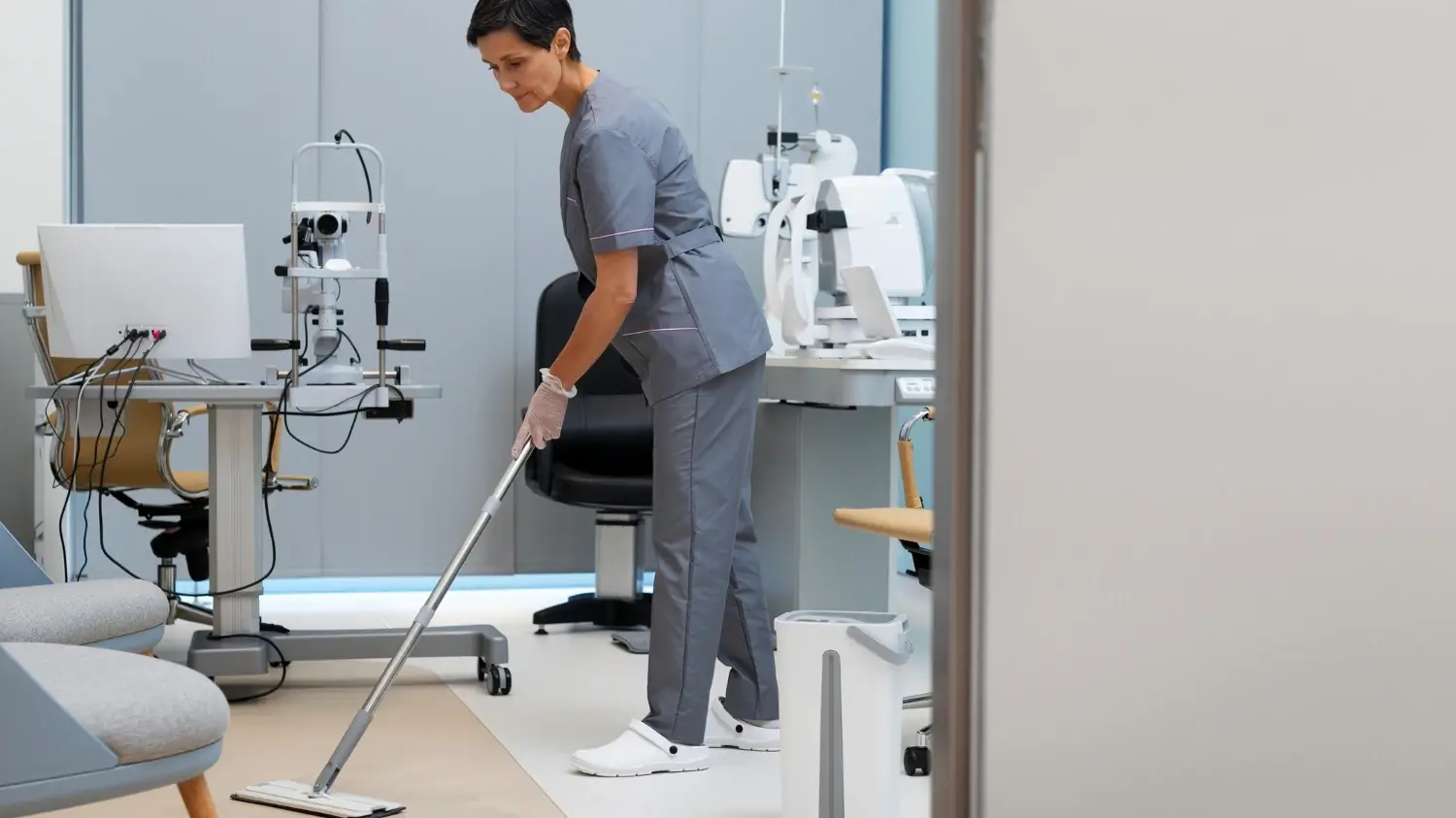
Medical offices face cleaning standards that go far beyond what is expected in a typical commercial space. Patients in waiting rooms and exam areas are often immunocompromised, recovering from illness, or particularly vulnerable to infection. The reception area, exam rooms, restrooms, and every shared surface must meet a level of hygiene that protects patients, staff, and the practice itself.
For medical practices in Maryland, including Bethesda, Rockville, Silver Spring, and the broader DMV region, professional office cleaning is not optional. It is a compliance requirement and a patient safety responsibility.
Why Medical Office Cleaning Is Different
Standard office cleaning focuses on removing visible dirt and maintaining a professional appearance. Medical office cleaning goes further. It requires:
- Proper sanitizing of surfaces that may carry pathogens
- Reception area cleaning that reduces cross-contamination between patients
- Protocols for handling biohazardous materials safely
- Compliance with OSHA bloodborne pathogen standards where applicable
- Documented cleaning processes that can support accreditation requirements
The distinction between cleaning (removing visible dirt), sanitizing (reducing bacteria to safe levels), and disinfecting (eliminating nearly all pathogens) is critical in medical environments. Each area of a medical office may require a different standard.
Standard 1: Reception Area Cleaning Prioritizes High-Touch Surfaces
The reception area is the highest cross-contamination risk zone in any medical office. Patients of all health statuses check in, sit, and handle surfaces here. Without consistent, thorough reception area cleaning, viruses and bacteria are easily transmitted.
Critical reception area surfaces include:
- Check-in desk and counter surfaces
- Pens and styluses used for patient check-in
- Chair arms and seating surfaces in the waiting room
- Door handles, including the main entry and any interior doors
- Payment terminals and card readers
- Clipboards, tablets, and any shared patient intake materials
- Magazine racks and their contents (many practices have removed these for exactly this reason)
Reception area cleaning should include disinfection of all these surfaces at minimum once daily, and more frequently during busy periods.
Standard 2: Restroom Sanitizing in Medical Settings
Medical office restrooms require a higher standard of sanitizing than typical commercial restrooms. Patients using these facilities may have infectious conditions, and contamination can persist on surfaces for extended periods.
A professional office restroom sanitizing protocol includes:
- Full disinfection of toilet surfaces, including the seat, flush handle, and tank exterior
- Sink, faucet, and soap dispenser disinfection
- Floor cleaning with hospital-grade disinfectant
- Mirror and counter cleaning
- High-touch surface focus: door handles, paper towel dispensers, light switches
- Restocking supplies (paper towels, soap, toilet paper) to appropriate levels
For medical offices in Bethesda and across Maryland, restroom cleaning frequency should be daily at minimum, with multiple daily checks in busy practices.
Standard 3: Exam Room Protocols Between Patients
Exam rooms require thorough disinfection between patient visits. This is typically handled by clinical staff using practice-specific protocols. However, daily end-of-day deep cleaning of exam rooms is the responsibility of the professional cleaning service.
Daily exam room cleaning includes:
- Disinfecting examination tables and all equipment surfaces
- Cleaning all counters, cabinets, and shelving
- Mopping floors with appropriate disinfectant
- Emptying biohazard containers per protocol
- Cleaning sinks, faucets, and high-touch surfaces
- Cleaning light fixtures and switches
The professional cleaning team should never handle biohazardous waste beyond what is explicitly covered in their service agreement and training. Clinical staff should manage sharps containers and specimen handling.
Standard 4: OSHA Compliance for Professional Cleaning Teams
Medical offices that engage professional cleaning services must ensure those cleaners comply with OSHA’s Bloodborne Pathogens Standard (29 CFR 1910.1030). This standard applies when employees are reasonably anticipated to come into contact with blood or other potentially infectious materials.
For professional cleaning teams working in medical offices, this means:
- Training on bloodborne pathogen exposure risks
- Proper use of personal protective equipment (PPE)
- Understanding of how to handle potential exposures
- Awareness of which areas and materials pose exposure risk
At Clean Day Maids, our team follows commercial cleaning protocols that account for the specific requirements of medical and clinical environments. We work with each practice to ensure our approach aligns with their safety requirements.
Standard 5: Customized Office Cleaning Plan for Each Practice
No two medical practices have the same layout, patient volume, or service type. A general practitioner’s office in Rockville has different cleaning requirements than a dermatology clinic in Bethesda or a physical therapy practice in Silver Spring.
An effective medical office cleaning plan is customized to account for:
- The specific areas of the practice and their usage frequency
- Patient volume and peak hours
- Special areas such as procedure rooms, lab areas, or imaging rooms
- Frequency requirements for each area based on risk level
- Products appropriate for specific surface types and medical equipment
Our office cleaning services include customized plan development for each commercial client, including medical practices. We do not apply a generic template to a specialized environment.
Standard 6: Documentation and Consistency
In healthcare settings, documentation matters. Cleaning logs, product records, and service verification are often required for accreditation purposes and can be requested during regulatory inspections.
A professional cleaning service should provide:
- Clear documentation of what is cleaned on each visit
- Records of products used, including safety data sheets
- Consistent team assignments so staff know who is in the facility
- A point of contact for issues or adjustments to the cleaning plan
Consistency is equally important. A medical office that has different people cleaning it each week cannot maintain reliable standards. Regular, assigned cleaning staff build familiarity with the facility and deliver predictable results.
Serving Medical Practices in Bethesda, Rockville, and the DMV Region
Clean Day Maids provides professional medical office cleaning services for practices throughout Maryland, DC, and Virginia. Our team is fully insured, bonded, and background-checked. We understand the specific requirements of medical environments and build our protocols accordingly.
We also serve non-medical commercial clients with our standard commercial cleaning services and residential cleaning services for households in the same communities.
A Clean Medical Office Is a Safe Medical Office
For medical practices in Maryland, reception area cleaning, restroom sanitizing, and exam room maintenance are not just about appearance. They are about patient safety, staff protection, and the credibility of your practice.
A professional cleaning service that understands the standards applicable to medical environments is a direct investment in all three.
Contact Clean Day Maids to discuss a customized cleaning plan for your medical practice in Bethesda, Rockville, Silver Spring, or anywhere in the DMV area.
Infection Control in High-Risk Waiting Areas
Medical waiting rooms present a unique infection control challenge. Patients with active illness sit adjacent to patients who are not yet ill. Children touch toys and seating surfaces that adults then use. The turnover of patients through a waiting room can be rapid, leaving little time for cleaning between occupants.
Professional reception area cleaning addresses this by establishing a baseline that is maintained consistently. When the waiting room starts each day in a fully sanitized condition, and high-touch surfaces are addressed between patient peaks, the infection transmission risk in the waiting room stays as low as possible.
For practices that treat high volumes of patients with infectious conditions, this is not a peripheral concern. It is central to your standard of care.
Protecting Your Staff With Consistent Cleaning Standards
The health of your clinical and administrative staff is equally important to patient safety. Staff who work in an under-cleaned medical office face ongoing exposure to pathogens brought in by patients. Over time, this exposure increases sick days and turnover.
Consistent professional office cleaning protects your team by maintaining the sanitizing standards they deserve. A clean reception area, clean restrooms, and clean shared work areas reduce the pathogen burden throughout the office and protect the people who work there every day.
Partner With Clean Day Maids for Your Maryland Medical Practice
Clean Day Maids provides customized medical office cleaning services for practices throughout Maryland, DC, and Virginia. We understand the specific requirements of healthcare environments and build cleaning protocols that address both compliance and patient safety.
Our team is fully insured, bonded, and background-checked. We use appropriate disinfectants for medical settings and document our services for your records.
Contact us to discuss a cleaning plan tailored to your practice’s needs and schedule.
Customized Cleaning Frequencies for Different Practice Types
Not every medical practice has the same cleaning needs. A general practitioner seeing 30 patients a day in Bethesda has different requirements than a specialty clinic with lower patient volume but higher procedural complexity.
Clean Day Maids works with each medical practice to determine the right cleaning frequency for their specific environment.
Common frameworks:
- High-volume primary care: Daily cleaning of reception, restrooms, and all patient-facing areas, with weekly attention to administrative spaces and storage
- Specialty clinics: Daily sanitizing of procedure-adjacent areas, bi-weekly deep cleaning of waiting areas and administrative zones
- Medical offices with evening hours: After-hours cleaning that works around extended clinic schedules, ensuring the facility is fully clean before the first patients arrive each morning
Whatever your practice’s schedule and volume, Clean Day Maids builds a plan that meets your compliance requirements and your patients’ expectations.
The Value of Consistent Documentation
For medical practices that are subject to accreditation reviews, state health inspections, or payer audits, having documented cleaning records is a material asset. Clean Day Maids provides service documentation for each visit, including what was cleaned, what products were used, and when the service was completed.
This documentation is available on request and can be formatted to meet the requirements of your accreditation body or state health department.
Maintaining these records does not require extra effort on your part. It is part of how we operate with every commercial medical client.
Reception Area Cleaning as Patient Experience
The reception area is not just an infection control concern. It is also the first point of contact between your practice and your patients. A clean, welcoming reception area communicates professionalism and care before a single word is spoken.
Patients who sit in a visibly clean waiting room feel more confident in the quality of care they are about to receive. Patients who sit in a dirty or neglected waiting room arrive at their appointment with reduced confidence and increased anxiety.
Reception area cleaning is therefore simultaneously a safety measure and a patient experience investment. Treating it as both, with the rigor that both require, is the right approach for any Maryland medical practice committed to excellence.